Last week we had the pleasure of meeting with most of our distributors and it was a great success!
Thank you all very much for the positive energy and for making those days an inspiration for everyone.
We look forward to seeing you next time!

 Elisabet Nuñez Gaitan
Last week we had the pleasure of meeting with most of our distributors and it was a great success!
Thank you all very much for the positive energy and for making those days an inspiration for everyone.
We look forward to seeing you next time!

Work in the lab can be chaotic and stressful...
so why make it more difficult?
Keep it simple with the Dilucup System!

Our facilities will remain open during the summer and you will be able to place your orders as usual.
About the photo: Hervé took this photo a few days ago on one of his bike tours along the beautiful west coast of Sweden nearby Gothenburg.
What a nice view, don’t you think?
Have a great summer! 🙂
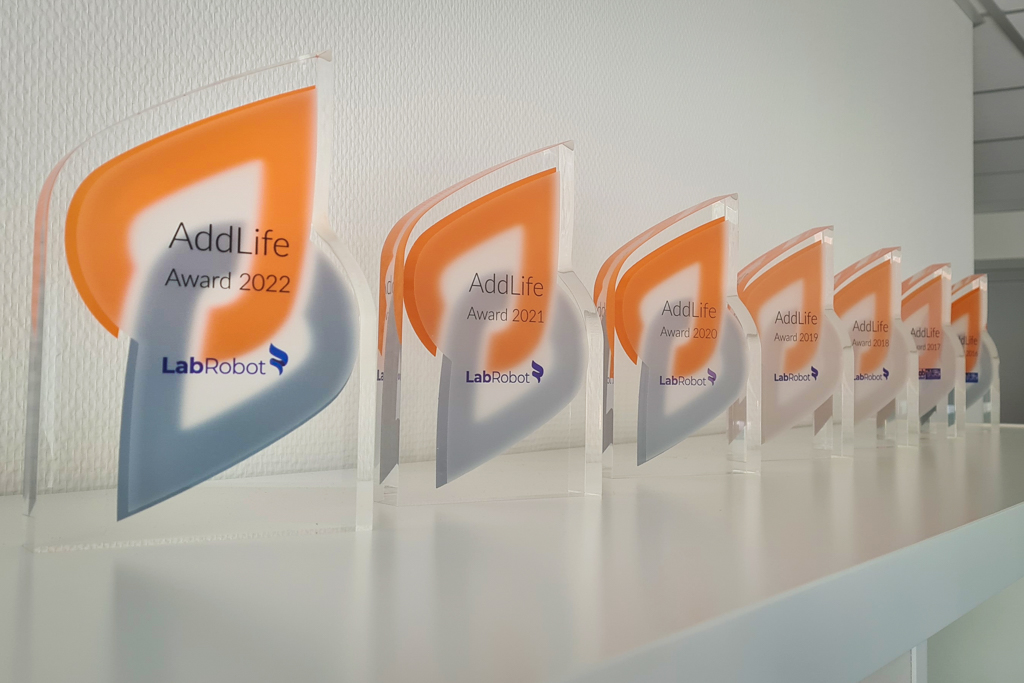
We are so happy to share that we received a new award for our sustained growth in the Addlife group!
This award is the result of the hard work, dedication and innovative strategies of our entire team. We could not achieve this without the support and trust of our valued customers, who are the key to our success.
Thank you for your continued partnership!

Glad Påsk!
Happy Easter!
Hyvää pääsiäistä!
Joyeuses Pâques!
Felices Pascuas!
Frohe Ostern!
Best wishes from the LabRobot team 
The volume of a diluent must be accurate to have reliable results and according to EN ISO 6887-1: 2017
the volume should not deviate from 9,0 mL ± 2 % (9 mL ± 0,18 mL).
We want to be better than this
and that is why Dilucup® aims for a volume range of 9 mL ± 1 %.
99,95% of the 25.000 latest Dilucups analysed in our QC laboratory
had a volume of 9 mL ± 1 %,
with an average of 9 mL + 0,26 % mL (9,02 mL)
and a SD of 0,21 %.
Pretty good volume accuracy, don’t you think?
Watch the video to learn about our latest analysis!
The ergonomic solution for serial dilutions
Have you ever got pain in your wrist or joints?
If so, you surely know how limiting it can be,
requiring sometimes even months of sick leave to recover.
When you use a vortex mixer
vibrations are absorbed by your hand/wrist.
With the Dilucup system,
the shaker is the one that absorbs all movements,
so your joints don’t suffer any damage.
Our serial dilution system
protects you against
repetitive strain injuries in hands or wrists.
It’s really comfortable to use.
Try it and you won’t regret!
Don't let a vortex ruin your well-being!
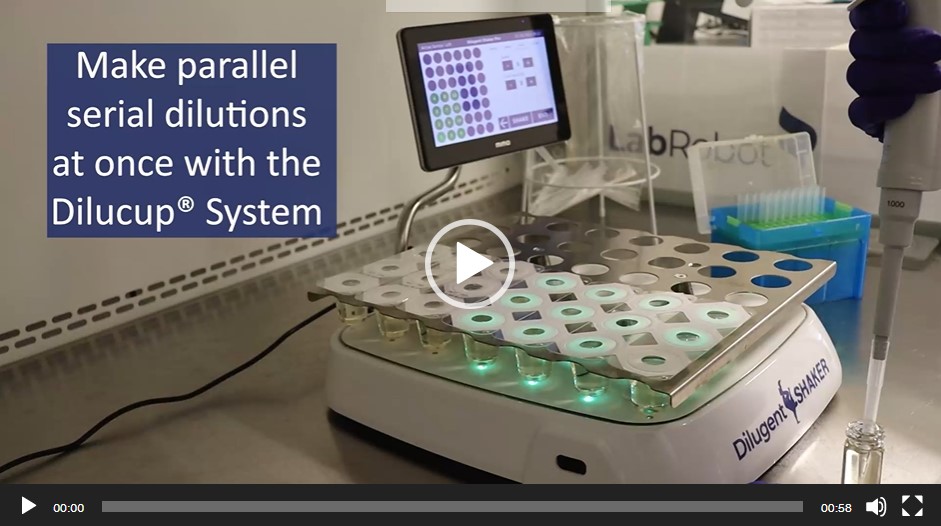
How to make multiple serial dilutions at the same time?
Making many serial dilutions can be time consuming and monotonous.
Have you never thought about making multiple serial dilutions at the same time?
This is possible with Dilugent® Shaker Pro!
You can dilute up to 7 samples at the same time without getting lost.
Watch the video to see an example!
Thank you very much for this year!
Note that LabRobot will be closed during week 52 (26th ‐ 30th December).
So if you need a new supply of Dilucup pallets before the end of the year,
we need to have your order in by December 20th. We will also be able to process small express orders (one pallet max.) for those placed up until the 28th.
Have a magical Christmas holidays! 
How to enumerate the microorganisms in a food sample using Dilucup?
Watch the video to understand it better!